
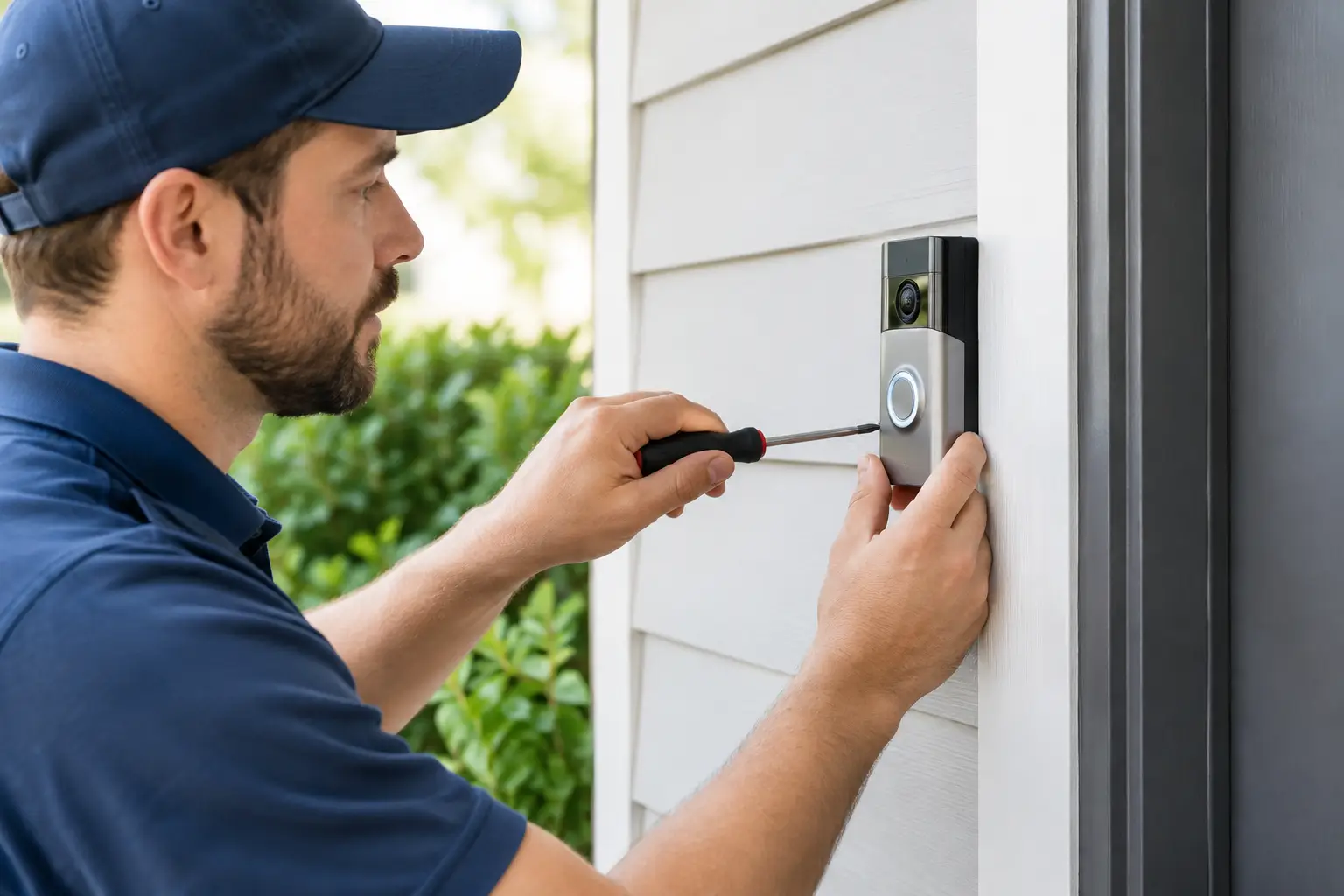
A battery doorbell that needs charging just as you are leaving for work soon becomes a nuisance. A wired Ring doorbell installation gives you a constantly powered doorbell, dependable alerts and no ladder trips to recharge a battery. Done properly, it should also look like it has always belonged on the front of your home - with no loose cables, failed chime or unreliable connection.
Why choose a wired Ring doorbell?
The main advantage is power. A hard-wired doorbell takes a steady low-voltage supply from your existing doorbell wiring or a suitable new supply, so the camera is ready to record and notify you without relying on battery level. This is particularly useful on busy family homes, rental properties and homes where the front door gets plenty of visitors or deliveries.
It can also be the tidier choice. Rather than running a charging routine, you have one fixed installation that can be tested properly at the time of fitting. That said, wired is not automatically right for every property. If there is no usable cable at the door, the existing transformer is unsuitable, or getting a new cable there would mean unnecessary disruption, a battery model with a sensible charging plan may be better value.
The best answer depends on the building, the Ring model and what you want the doorbell to do. Honest advice starts with checking what is already in place, not selling equipment before the wiring has been assessed.
What needs checking before wired Ring doorbell installation
Older doorbells can be deceptively simple. You may see a push button and an indoor chime, but behind them there could be ageing cable, a transformer with insufficient output, a mains-powered chime, or wiring that has been altered during previous decorating work. A doorbell may light up initially but still drop offline, fail to ring indoors or struggle when night recording is active.
First, confirm the exact Ring doorbell model. Power requirements differ between products, so never assume that any existing doorbell supply will do. The transformer needs to provide the correct type and level of power for that model, and the cable needs to be in sound condition. Where an internal chime is being retained, it must be compatible and configured correctly. Some installations need a supplied chime connector or bypass arrangement; others are better served by a separate indoor chime unit.
Wi-Fi deserves the same attention as the wiring. Your front door is often at the edge of the home network, especially in a larger house, a property with thick walls, or a flat with a router positioned at the back. A powered video doorbell cannot provide useful security footage if the wireless signal is weak. Sometimes moving the router, adding a Wi-Fi access point or improving the network is the sensible fix rather than blaming the doorbell.
How a tidy installation should be carried out
A proper fitting starts with choosing the camera position. The lens needs a clear view of visitors approaching the door, not just the top of their heads or a large section of pavement. Height, angle and the direction of sunlight all affect the image. A wedge mount can make a real difference where the doorbell sits on a side wall or the approach comes from one direction.
The power is then isolated and tested before any connections are made. If existing doorbell cable is usable, it can be terminated neatly behind the Ring unit. If a new cable is needed, it should be routed discreetly and protected rather than clipped across brickwork as an afterthought. The aim is simple: no exposed joins, no trailing flex and no damage caused by drilling into an unsuitable location.
Once fitted, the unit needs more than a quick power-on. The installation should include connection to the home Wi-Fi, app setup, live-view testing, two-way audio checks and motion testing from the pavement or driveway. If you want alerts shared with a partner or family member, that can be set up at the same time. Privacy zones and motion areas should be adjusted so you are notified about someone at your door, rather than every passing car or neighbour walking home.
If the existing mechanical chime is staying, test that too. A doorbell notification on a phone is useful, but it should not leave someone in the house wondering why the old chime no longer works. Where a chime cannot be retained safely or reliably, it is better to explain that clearly and provide a practical alternative.
Placement matters more than most people expect
Mounting a camera too low makes it easy to tamper with. Mounting it too high can miss parcels left on the step and give a poor view of faces. Avoid pointing directly into strong afternoon sun where possible, and be mindful of reflective glass, polished door furniture and security lights that can affect night footage.
Think about the route a visitor takes. If the gate, path or parking space is off to one side, the standard straight-ahead mounting position may not capture the useful angle. A small adjustment before drilling is far easier than living with a camera that records the wrong part of the frontage.
Common problems with existing wired Ring doorbells
A Ring doorbell that repeatedly disconnects is not always a Wi-Fi issue. Low or unstable power can cause intermittent faults that look like a network problem. Equally, an indoor chime that buzzes, rings continuously or has stopped altogether may point to an incorrect chime setup, incompatible hardware or a transformer that needs attention.
Poor picture quality is often about placement or Wi-Fi signal, while missed motion events can come down to motion zones, sensitivity settings or the angle of the camera. These are fixable issues, but changing random settings in the app rarely solves an underlying power or cabling fault.
For landlords, a properly fitted wired doorbell is also easier to hand over between tenancies. The cable route is known, the equipment is securely mounted and the next occupier is not left trying to work out whether the device is connected to an old chime or a loose power supply.
When it is worth calling an installer
If your old doorbell is working and the wiring is clearly suitable, some homeowners will be comfortable fitting their own Ring unit. The trade-off is that fault-finding can take longer than expected, particularly when there is an old transformer, mixed wiring or a chime that does not behave as it should.
Professional help makes sense when new cable is required, the supply needs upgrading, the front door has difficult access, or you want the work completed and tested in one visit. It is also the safer route where electrical work goes beyond the low-voltage doorbell side of the job. Do not work on mains-connected equipment unless you are competent and the work is appropriate for you to carry out.
At Speedy Aerials, the job is assessed on what your home actually needs. That means fair pricing, tidy cable work and no unnecessary kit. A stocked van helps deal with common chime, cabling and Wi-Fi issues without turning a straightforward doorbell installation into several appointments.
Questions homeowners often ask
Will my existing doorbell wiring work?
Possibly, but it needs testing. The visible cable alone does not confirm that the transformer output, cable condition and chime arrangement are suitable for your chosen Ring model.
Can I keep my indoor chime?
Often, yes. It depends on the chime and doorbell model. If it is not compatible, a separate plug-in chime can be a more reliable solution than trying to force an old unit to work.
Does a wired doorbell still need Wi-Fi?
Yes. The cable provides power, not internet access. Reliable Wi-Fi at the front door is essential for live video, notifications and recorded events.
Can the camera be angled away from the road or a neighbour's property?
Yes. Correct positioning, wedge mounts and privacy settings can help focus the view on your entrance while reducing unnecessary coverage beyond your boundary.
Before choosing a spot, stand where a visitor would stand and look back at the door. That simple check often shows whether the doorbell will capture a face, a parcel and the approach - which is what you need it to do when somebody presses the button.