
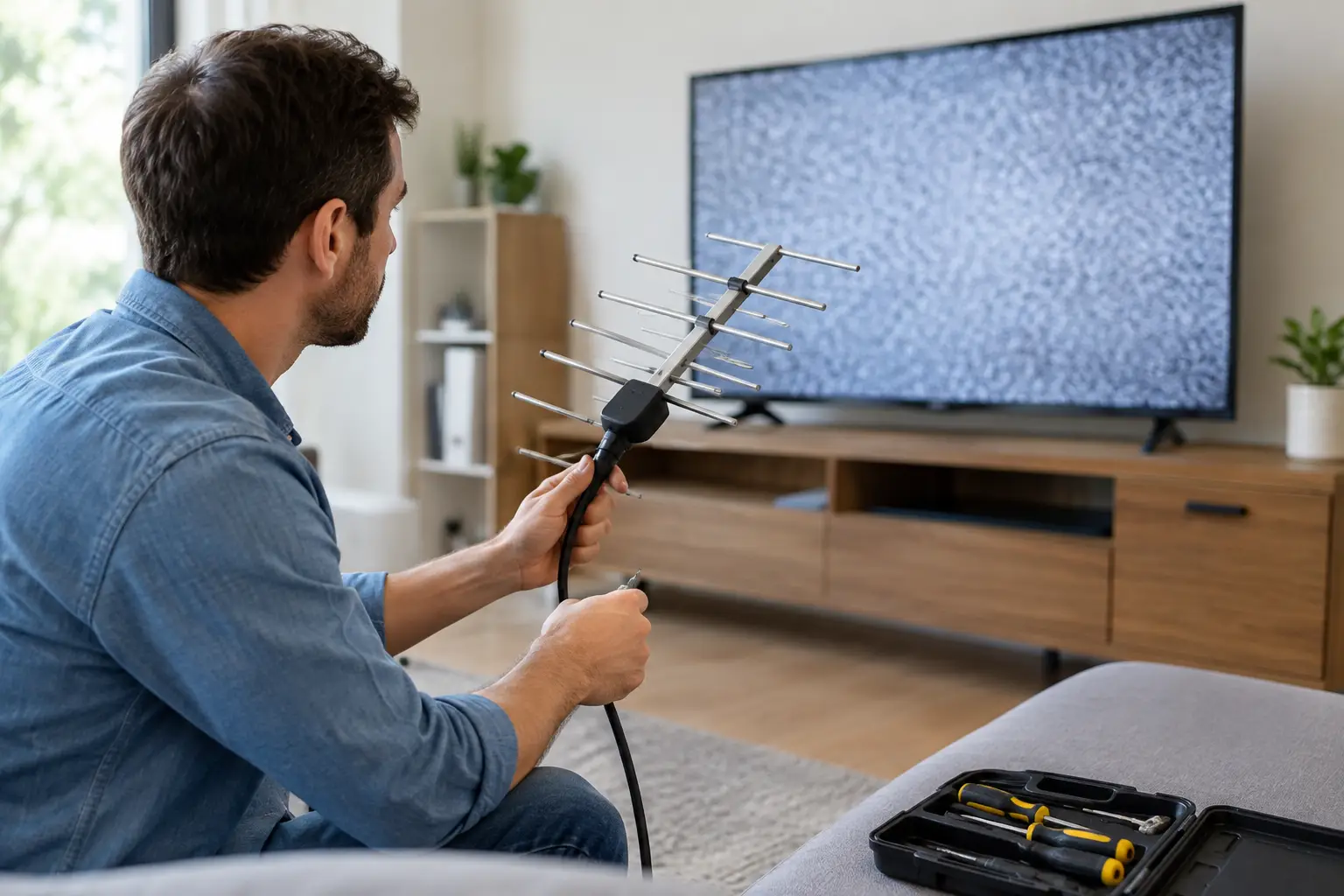
A football match freezing just as a goal is scored, a screen saying ‘no signal’, or channels that vanish overnight are all frustratingly familiar TV reception problems. The good news is that the television is rarely the real issue. More often, the fault sits somewhere between the aerial or dish and the socket behind the TV - and the right repair is usually simpler than replacing everything.
What poor TV reception looks like
TV faults do not always present themselves in the same way. Pixelated pictures, sound cutting out and channels breaking up usually point to a weak or unstable signal. A completely blank screen with a ‘no signal’ message can mean a disconnected lead, a failed amplifier, a faulty aerial system or the TV being set to the wrong input.
If only one television is affected, start by looking at that room. If every TV in the house has failed, the cause is more likely to be outside, in the loft, or within shared distribution equipment. That distinction saves time and stops you paying for kit you do not need.
Common causes of TV reception problems
Damaged aerials, dishes and brackets
Your aerial or satellite dish spends every day exposed to wind, rain and temperature changes. Over time, brackets can loosen, aerial elements can corrode and a dish can move slightly out of alignment. It does not need to look as though it is hanging off the chimney to cause a problem. A small movement can be enough to weaken satellite reception, particularly in heavy rain.
Older aerials are also often fitted with ageing cable and connectors. Water gets into a cracked outer cable sheath, travels along the cable and causes corrosion where you cannot see it. The result may be an intermittent fault that seems worse in wet or windy weather.
Worn, pinched or loose cables
The short flylead between the wall socket and television is an easy thing to overlook. A loose plug, bent centre pin or cheaply made lead can reduce the signal enough to cause picture break-up. It is worth checking that both ends are firmly connected and that the cable has not been trapped behind furniture or pulled tight.
The longer cable run matters just as much. Cables routed around windows, across loft spaces or down outside walls eventually degrade. A tidy, correctly clipped replacement cable often solves a fault that has been blamed on the aerial for months.
Failed boosters and power supplies
Some homes need a signal amplifier or booster, especially where one aerial feeds several rooms. These units require power, so a failed power supply, switched-off plug socket or blown component can take out reception throughout the property.
A booster is not automatically the answer to poor reception, though. Amplifying a weak, noisy signal can make matters worse. The first job is to establish whether the aerial is receiving a usable signal and whether the distribution system is installed correctly. We will not sell you kit you do not need.
Weather, trees and local obstructions
Bad weather can expose an existing weakness in an aerial or dish system, but it should not regularly wipe out your television. Strong winds may shift poorly secured equipment. Heavy rain can affect a marginal satellite signal. Trees that have grown into the line of sight can also affect a dish, particularly in summer when foliage is thicker.
For Freeview aerial systems, local terrain and the transmitter serving your address also matter. Homes in valleys, rural locations or behind tall buildings sometimes need a better-positioned aerial or a more suitable aerial type. Bigger is not always better - correct placement and proper testing are what count.
Television settings and retuning
A television can lose channels after a retune, a software update or a power cut. If the screen is blank, first check that the TV is on the correct source. It may be set to HDMI rather than the built-in TV tuner, or vice versa.
Retuning can help after a confirmed transmitter change or when a new aerial has been fitted. Avoid repeatedly retuning during an active signal fault. The TV may store weak or incorrect channel data, leaving you with even fewer channels when the signal returns. Fix the cause first, then tune the set properly.
Safe checks to make before booking a repair
There are a few sensible checks you can make from ground level. Confirm that the TV has power, the aerial lead is secure, and the correct input is selected. If you have another television in the house, try it on the same wall socket with the same lead. If it works, the issue may be with the original TV or its settings.
Where you use Sky, Sky Q, Freesat or another satellite receiver, check the HDMI lead and make sure the receiver has power. A reboot can clear a temporary box fault, but do not reset a service you are unsure about, as this can remove settings or recordings.
Do not climb onto a roof, lean a ladder against a chimney or try to realign a dish yourself. Apart from the obvious safety risk, it is easy to damage tiles, cable connections or the dish mount. A signal meter and the right test equipment give a proper answer far more quickly than adjusting equipment by eye.
When a repair is better than a new installation
A full replacement is not always necessary. If the aerial is sound but the cable has failed, replacing the cable may be all that is required. If a dish has shifted in the wind, a secure realignment and new weatherproof connectors can restore the service. If a splitter or amplifier has failed, that component can often be replaced without disturbing the aerial.
Replacement becomes more sensible when equipment is old, corroded, poorly mounted or unsuitable for the property. For example, an aerial fitted years ago for one TV may struggle when it is split across four rooms. Equally, an old dish bracket fixed into tired mortar is not something to patch up repeatedly. Good advice means explaining both options and the likely lifespan of each, not pushing the most expensive job.
A proper TV reception diagnosis
A proper diagnosis starts at the television socket and works back through the system. Signal strength alone is not the whole story. Signal quality, error levels, cable condition, power supplies and the condition of connectors all need checking.
The engineer should then inspect the aerial or dish mounting, alignment and external cable route before recommending work. That method identifies the actual fault rather than treating the symptom. It is also the best way to avoid repeat call-outs.
At Speedy Aerials, the aim is to diagnose, repair and fully test the system on the same visit wherever possible. Stocked vans help, but the important part is the approach: fix what is wrong, leave cables tidy, tune the TV if needed and make sure the channels are working before leaving. Parts and labour are covered by a no-nonsense two-year warranty.
TV reception in rented homes and shared buildings
Tenants should check whether the aerial serves only their flat or is part of a shared system. In a block of flats, a communal aerial or satellite system may be maintained by the landlord, managing agent or freeholder. If neighbours have the same fault, report that detail straight away - it points towards a communal issue.
Landlords benefit from resolving reception faults properly rather than fitting temporary indoor aerials. Indoor aerials can work in a strong-signal area, but they are unreliable in many homes and can create repeat complaints. A tested fixed system is usually the better long-term answer.
Frequently asked questions about TV reception
Why does my TV picture break up at night?
This can happen when the signal is already borderline and conditions change. It may also be caused by electrical interference, a failing amplifier or moisture in a cable. Testing the signal at different points in the system will narrow it down.
Can I watch Freeview without an aerial?
You can use internet-based television services if your broadband is reliable, but Freeview through the TV tuner needs an aerial signal. Whether switching makes sense depends on your viewing habits, broadband speed and whether you want a back-up option during internet outages.
Why has my TV lost some channels but not all of them?
Different channel groups are broadcast on different frequencies. A weak aerial system may receive one group adequately while missing another. It can also happen after an incorrect retune, so avoid assuming the aerial needs replacing without testing it.
If your screen is blank or the picture is breaking up, take note of exactly what happens and whether other rooms are affected. That small bit of information makes the fault easier to pinpoint, and a proper repair means you can get back to watching television without wondering when the signal will disappear again.