
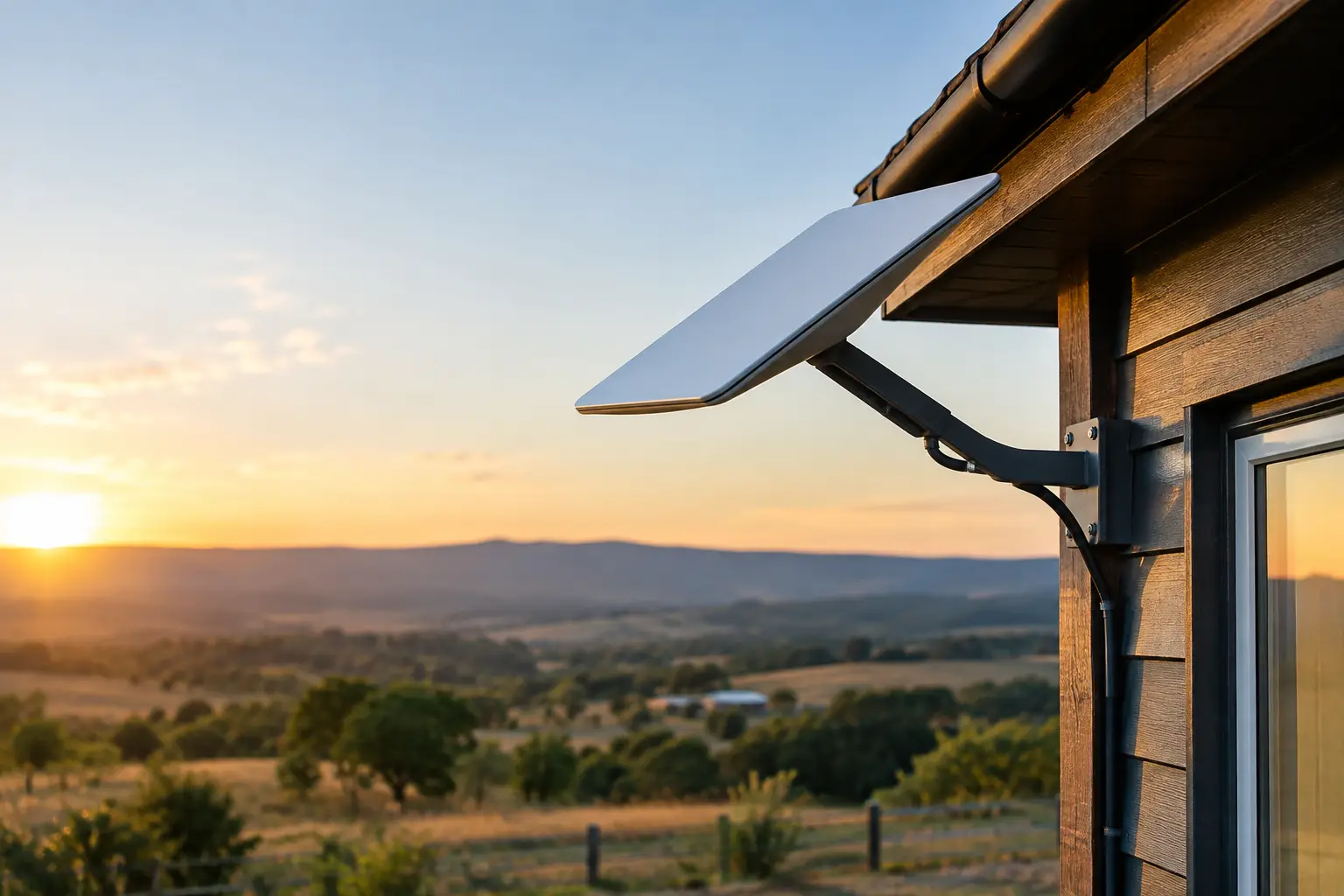
A rural broadband problem is rarely solved by simply putting a dish on the nearest wall. Starlink mounting for rural homes has to deal with mature trees, uneven roofs, long drives, exposed gable ends and cable routes that were never designed for modern internet equipment. Get the position wrong and a fast new connection can become another unreliable household headache.
A proper installation starts with the view of the sky, not the bracket. The dish needs a wide, unobstructed area to communicate with satellites overhead. A chimney, ridge line or nearby tree may look harmless from ground level but can cause brief dropouts that matter when someone is on a video call, gaming online or trying to stream television in the evening.
Start with the sky view, not the roof
Starlink equipment continuously changes which satellites it uses. That means it does not work like a traditional TV satellite dish aimed at one fixed point in the sky. It needs a broad clear view, and obstructions can interrupt the service as satellites pass behind them.
Before choosing a mounting point, assess the property from the places that offer the best height and clearance. This might be the roof, a gable wall, an outbuilding or a purpose-fitted pole. The Starlink app can help identify obstructions, but it should be used as part of a proper site survey rather than as a reason to guess from the garden.
Trees are the usual issue at country properties. Bare branches in winter can become a dense canopy by late spring. A location that appears clear in January may be poor by June. Equally, do not assume a very high roof is automatically best. A lower wall mount can be the better choice if it has a clear sky view, allows a shorter cable run and can be fixed securely into sound brickwork.
The best Starlink mounting options for rural homes
There is no one bracket that suits every house. The right fixing depends on the building, available sky, exposure to wind and how neatly the cable can reach the router indoors.
Roof mounting
A roof mount often provides the clearest line of sight above hedges, barns and trees. It is useful on properties set below surrounding woodland or where the house has several nearby obstructions. However, the roof must be accessible and in good condition. Fixing through damaged tiles, loose ridge work or tired felt is asking for a leak later.
The dish should be mounted on a suitable mast and bracket, with the load spread across a solid fixing point. It also needs enough clearance to move and operate without striking tiles, guttering or nearby aerial equipment. A rushed installation with a flimsy bracket may survive a calm week, then work loose in the first proper gale.
Wall and gable mounting
A wall mount is often the tidiest and most practical option. A high gable can provide useful elevation without putting equipment on the roof, while a solid wall gives an engineer confidence that the fixing will remain stable.
This approach makes sense when there is a clear view over the roofline or open land. It also makes future access easier for checks, upgrades or repairs. The trade-off is that the dish may still be affected by a neighbouring tree or chimney, so height alone should never decide the location.
Pole mounting
Pole mounting can solve awkward rural sites where the house is shaded by trees or sits in a dip. A properly installed ground pole, fixed into a stable base, can put the dish where the sky is clearest without drilling into an older property or stretching cable across unsuitable roof areas.
This is not simply a case of pushing a pole into the lawn. It needs to be strong enough for the dish and local wind conditions, positioned away from vulnerable areas and planned around the cable route. A pole at the far end of a field may offer perfect reception but create an impractical, costly run back to the house.
Outbuildings and garages
A garage, workshop or stable can be a sensible mounting location, particularly if it sits on higher ground or beyond the tree line. Check that the cable can be routed safely and discreetly back to the main property. If power and networking are needed at the outbuilding too, this can be planned at the same time rather than relying on an unreliable Wi-Fi signal across the garden.
A secure bracket matters more than it looks
Starlink dishes are designed for outdoor use, but that does not mean every mounting method is suitable. Rural homes are often more exposed to wind, and an unsecured installation can twist, vibrate or pull on the cable. Even small movement can lead to damage over time.
The bracket, mast, fixings and wall or roof structure must work together. Good installation means using appropriate external-grade fittings, fixing into sound material and avoiding shortcuts such as mounting to loose cladding, weak timber or ageing fascia boards. The aim is not just to get the service working today. It is to leave it stable through rain, frost and high winds.
This is where experienced installation saves repeat visits. If a mount is installed properly, it should not need constant adjustment or become a source of water ingress. The same applies to any existing aerial or satellite equipment nearby. Keep the roofline tidy and avoid creating a tangle of brackets that makes future maintenance harder.
Plan the cable route before drilling
The dish is only half the job. The cable must enter the property safely, remain protected outdoors and reach the router where it will give the household the best possible coverage.
A neat route usually follows existing lines where sensible, such as a corner, soffit or service entry point. External cable should be clipped securely rather than left hanging in the wind. Where it enters the building, the hole should be carefully positioned, weather sealed and finished cleanly inside. Nobody wants a new broadband service with a visible cable draped across the front of the house.
Think about where the router will live as well. A cupboard at one end of a thick-walled farmhouse may be convenient for the cable but poor for Wi-Fi. Sometimes the best answer is a planned data cable run and a Wi-Fi access point, so bedrooms, home offices and garden rooms receive a usable signal too.
Do not ignore power, networking and backup needs
Starlink needs a reliable indoor power point for its equipment. Avoid overloading extension leads or placing power supplies in damp garages, lofts or inaccessible cupboards. If the router is positioned away from the main living area, consider whether wired connections are needed for a smart TV, games console, office computer or CCTV recorder.
Rural customers often choose Starlink because their previous connection was slow or unreliable. That makes it worth discussing the whole setup, not just the dish. A strong connection arriving at the router can still feel disappointing if Wi-Fi cannot pass through stone walls, foil-backed insulation or multiple floors.
For households that work from home, a wired Ethernet connection to the office can be more dependable than relying entirely on wireless coverage. For security systems and video doorbells, stable connectivity is equally useful. The right installation should make day-to-day use easier, not just produce a good speed test beside the router.
When a professional installation is worth it
Some Starlink kits include a basic stand, and this can be fine for a temporary test in an open garden. It is rarely the best long-term answer for a family home. Loose ground mounting is vulnerable to wind, accidental knocks, garden work and theft, while trailing cables create a trip hazard and are easily damaged.
Professional fitting is particularly worthwhile where the dish needs roof access, a high wall bracket, a pole, a long cable run or careful work around older tiles and brickwork. It is also sensible for landlords who need a tidy, durable installation that does not leave tenants managing faults or exposed wiring.
At Speedy Aerials, the approach is straightforward: assess the signal path, explain the sensible options, fit only what the property needs and test the full connection before leaving. There is no point fitting an expensive bracket or extra kit where a simpler, secure solution will do the job.
If you are planning Starlink for a rural home, take a moment to look beyond the dish itself. A clear sky view, sound fixing, protected cable route and sensible router position are what turn satellite internet into dependable broadband for the whole household.