
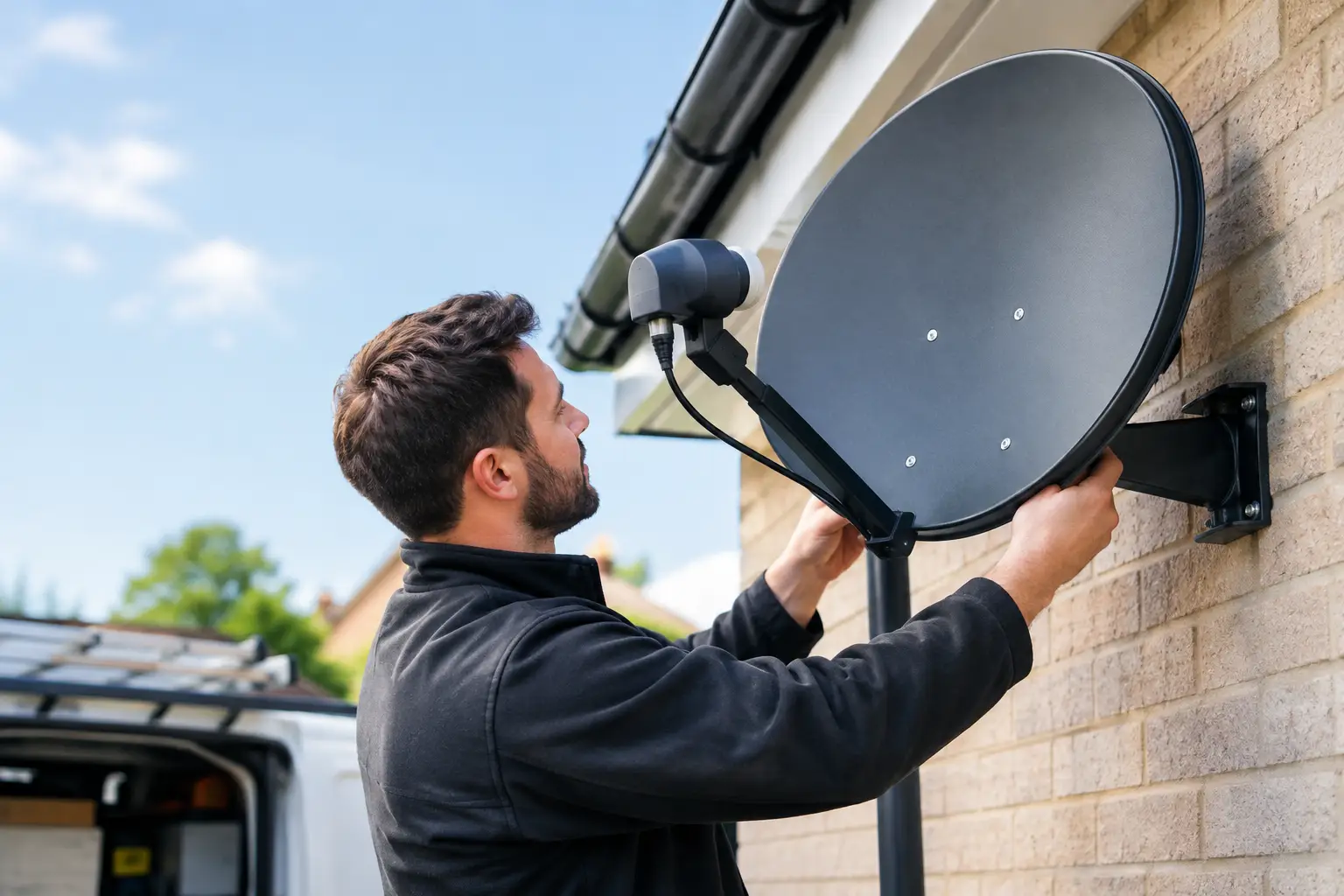
A Sky Q satellite installation should not leave you with a cable draped across the brickwork, a loose dish bracket or a picture that fails every time the weather turns. The job is about more than getting channels on the screen. It is about fitting the right equipment for your property, getting a dependable signal and leaving everything tidy, tested and easy to use.
For many households, the call comes after a move, a renovation or a frustrating spell of pixelated pictures and failed recordings. Some need a new dish; others already have one but need it checked, realigned or upgraded for Sky Q. The right answer depends on the condition of the existing system, how many rooms need Sky and whether your home has any awkward access or cabling issues.
What a Sky Q satellite installation involves
Sky Q uses a satellite dish to feed the main Sky Q box. Unlike older Sky systems, it normally requires a compatible wideband LNB, which is the small unit on the arm of the dish that receives the signal. An old dish may look fine from the ground but still have the wrong LNB, tired cable, water-damaged connections or a bracket that has started to pull away from the wall.
A proper installation starts with the dish position. It needs a clear line of sight towards the satellite, a solid fixing point and safe access for future maintenance. Trees, scaffolding, new extensions and even a neighbour's growth can affect reception over time. Fitting a dish in the quickest available spot is not always the best long-term solution.
The cable route matters just as much. Cables should be clipped neatly, protected where they enter the property and kept out of the way of doors, gutters and obvious damage points. Indoors, the aim is to place the Sky Q box where it works for the room without creating a trail of visible cable across the floor.
Can your existing dish be used for Sky Q?
Often, yes. If the dish is structurally sound, correctly positioned and large enough for reliable reception, there may be no reason to replace it. A straightforward upgrade may only need a new wideband LNB, fresh cable and careful alignment. That can be a sensible way to keep costs down.
However, an existing dish should not be reused simply because it is already there. Rusted brackets, cracked plastic fittings, perished cable and poorly sealed joins are common causes of intermittent faults. A dish can also be slightly out of alignment and appear to work until heavy rain or wind reduces the signal margin.
At Speedy Aerials, the approach is simple: inspect what is in place, explain what is usable and only replace the parts that genuinely need replacing. We will not sell you kit you do not need. If a repair or upgrade gives the same reliable result as a full replacement, that is the sensible option.
How a professional Sky Q installation should be carried out
The first step is understanding how you use the system. A family with one main television has different needs from a household using Sky Q Mini boxes in bedrooms, a garden office or an annexe. The engineer should also check where the broadband router sits, because Mini boxes rely on the Sky Q network and poor Wi-Fi can affect their performance.
The installation itself should follow a practical order:
- Check the dish location, mounting surface and safe cable route.
- Fit or upgrade the LNB and satellite cable where required.
- Align the dish accurately and test the signal, not just the picture.
- Set up the main box, confirm channels and recordings work, then test any Mini boxes in the rooms where they will actually be used.
That final testing matters. A system that works beside the router may struggle upstairs behind thick walls or in a newer extension with foil-backed insulation. If the Sky Q network is weak in part of the house, a Wi-Fi access point, better router position or wired data connection may be the real fix. Replacing the dish will not cure an indoor Wi-Fi problem.
A tidy installation also considers future access. You should be able to redecorate, replace a television or have other work done without discovering loose connections hidden behind furniture. Small details, such as weatherproof external joints and sensible cable entry points, prevent many repeat call-outs.
Flats, communal systems and difficult properties
Not every property can have a standard dish fitted. Flats and managed developments may use a communal satellite system, and landlords or freeholders may have rules about external equipment. In these cases, permission may be needed before any new dish is installed.
Communal systems can support Sky Q, but compatibility varies. Some require an adapter or a specific connection arrangement rather than a standard wideband feed. It is worth checking this before booking Sky equipment or agreeing to any work. Guessing can mean an unnecessary visit and a system that still will not activate correctly.
Listed buildings, conservation areas and properties with restricted access also need a more careful approach. The priority is always a safe, secure installation that respects the property. Sometimes a better cable route or a repair to an existing dish is the practical answer; sometimes a dish installation is not suitable at all.
Sky Q Mini boxes need good home Wi-Fi
It is easy to blame the dish when a Mini box freezes or loses connection, but the satellite signal is only part of the picture. The main Sky Q box receives the dish feed. Mini boxes connect back through the Sky Q network, so weak coverage between rooms can lead to buffering, connection warnings or unreliable viewing.
Before adding more equipment, test the location. Thick walls, large homes, older properties and extensions are frequent trouble spots. A properly planned wired connection or Wi-Fi access point can make Sky Q Mini boxes far more dependable than a basic plug-in booster placed at random.
This is particularly useful in homes where the television setup is part of a larger project, such as wall mounting a TV, running Ethernet to a home office or improving coverage for smart doorbells and CCTV. One tidy visit can often sort the cabling and connectivity together rather than creating separate problems later.
When it is a repair, not a new installation
No signal messages, missing channels, recordings failing or pictures breaking up do not automatically mean you need a new Sky Q installation. The cause may be a damaged cable, failed LNB, loose connector, wind movement, water ingress or a dish that has shifted slightly.
A fault diagnosis should come before major work. An experienced engineer can test the signal at the dish and at the Sky box, identify where it is being lost and give you a clear choice of repair options. That is quicker and fairer than replacing everything on the assumption that the dish is at fault.
If the problem has appeared suddenly after high winds, building work or a storm, do not climb onto a roof or lean a ladder against the dish yourself. Apart from the obvious safety risk, it is easy to make a small alignment issue much worse.
Questions homeowners often ask
Do I need a new dish for Sky Q?
Not necessarily. Many existing dishes can be upgraded with a compatible LNB and new cable if the bracket, reflector and position are in good condition. A site check gives a reliable answer.
Can Sky Q work in more than one room?
Yes. Sky Q Mini boxes can be used in additional rooms, subject to your Sky subscription and a reliable connection back to the main box. Each room should be tested, especially in larger homes.
How long does installation take?
A straightforward job can often be completed in one visit. More time may be needed for difficult access, long cable routes, communal systems, multiple rooms or Wi-Fi improvements. You should know what is involved before work starts.
Will the cables be visible?
Some external cable is unavoidable, but it should be routed thoughtfully and clipped neatly. Where practical, cable can be concealed or run through less noticeable areas. The best route depends on the building and the television position.
If you need a Sky Q system fitted, upgraded or repaired across Hertfordshire and the surrounding areas, speak directly to Larry for a free call-out and clear quote. A properly aligned dish, sound cabling and tested indoor connection means you can get back to watching television rather than troubleshooting it.