
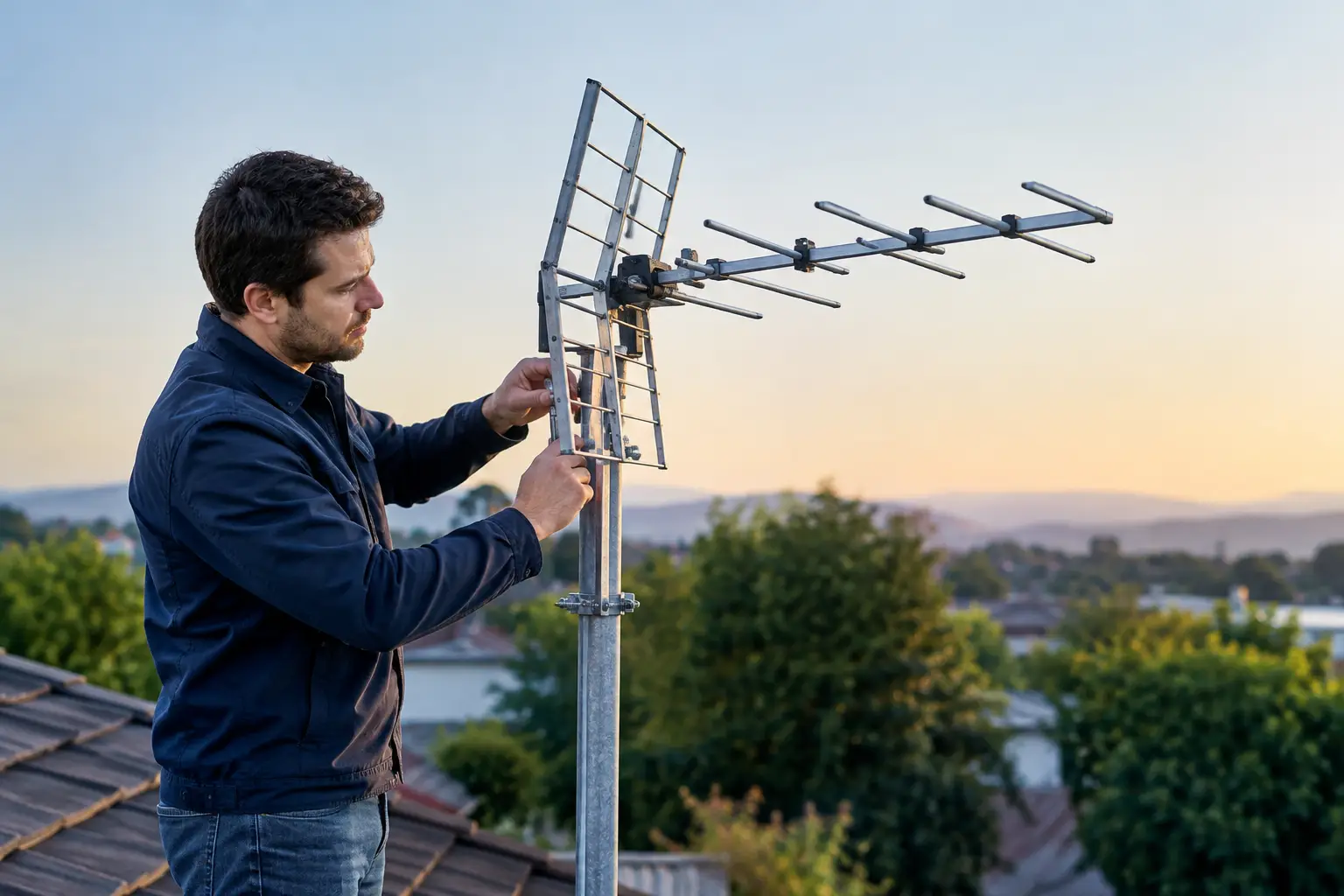
A picture that freezes during the football, channels that vanish overnight, or a screen that simply says “No Signal” can turn a quiet evening into a nuisance. The good news is that you can often improve TV reception without replacing everything. The key is finding where the signal is being lost, rather than buying a booster, aerial or new television on guesswork.
Most reception faults come down to one of three places: the aerial or satellite dish outside, the cable run into the property, or the connections and equipment by the TV. A proper diagnosis checks all three.
Start with the simple checks indoors
Before heading outside or arranging a repair, check the obvious points properly. A loose aerial lead can look connected while not making a clean contact. Unplug it from the back of the TV, wall socket and any splitter, then reconnect it firmly. Look for bent centre pins, damaged plugs or cable that has been trapped behind furniture.
If you use Freeview, open the TV’s signal information screen rather than relying only on the picture. Every make is slightly different, but it is usually found in Settings, Channels or Manual Tuning. Signal strength alone does not tell the whole story. Quality is often more useful. A strong but poor-quality signal can still give you blocky pictures, missing channels and sound drop-outs.
Try one TV directly from the main wall point, with no extension lead, splitter or amplifier in between. If reception improves, the fault is likely in the extra equipment or cabling rather than the aerial itself. If every TV in the house has the same problem, the issue is more likely to be outside or at the main distribution point.
Do not keep retuning a television with no usable signal. Retuning during a fault can remove the channels already stored, leaving you with more to put right once the actual problem is fixed.
Why TV reception suddenly gets worse
Aerial systems work reliably for years, which is why a sudden failure usually has a physical cause. Wind can twist an aerial slightly, loosen a bracket or move a satellite dish just enough to affect the signal. Heavy rain does not normally cause a healthy terrestrial aerial to fail, but it can expose cracked cable, water inside a connection or an ageing amplifier.
Trees growing into the signal path can matter too, particularly where the property is already on the edge of coverage. In some parts of Hertfordshire, Bedfordshire and the surrounding counties, the local terrain and transmitter direction mean a modest obstruction can make a noticeable difference.
Age is another common factor. Outdoor coaxial cable becomes brittle in sunlight. Water then enters through a split outer sheath or poorly sealed connector, corroding the cable from within. The system may work on a dry day and fail when the weather turns. Replacing one weather-damaged section of cable is usually a better fix than fitting extra signal boosters indoors.
How to improve TV reception at the source
The best way to improve TV reception is to make sure the signal reaching the house is clean, correctly aligned and protected from the weather. That starts with the aerial, dish or antenna position.
For Freeview, an aerial needs to be aimed at the right transmitter and mounted securely. Bigger is not automatically better. A high-gain aerial can help in a weak-signal location, but in a strong-signal area it may overload the equipment or pick up unwanted signals. The right aerial depends on local reception, nearby transmitters, the height of the property and whether surrounding buildings or trees block the path.
Satellite systems need even more accurate alignment. A dish can appear perfectly straight from ground level yet be a fraction out of position. Sky, Sky Q and Freesat services are less forgiving than many people expect, especially in bad weather. A professional meter allows an engineer to set the dish for signal quality, not just find a picture that happens to appear at the time.
Where a property has several TVs, the distribution equipment matters. A powered splitter or amplifier may be needed to feed rooms upstairs, a kitchen or a garden room, but it must be installed in the right place and matched to the signal available. Adding amplifiers one after another is a common cause of distorted or unstable reception.
Check the cable route, not just the aerial
A neat cable route is not just about appearance. External cable should be clipped securely, kept clear of sharp edges and taken into the property through a protected entry point. Loose cable flapping in the wind eventually fails. So do connections left exposed on a wall, chimney or fascia.
Inside, old wall plates, cheap fly leads and hidden junctions can reduce signal quality. This is particularly common after decorating, moving furniture, a loft conversion or a previous TV installation. An engineer can test the signal at the aerial, at the entry point and at each TV outlet to identify the exact point where it drops.
When a signal booster helps - and when it does not
A booster is useful only when there is a decent signal to boost. If the aerial is poorly aligned, the cable is waterlogged or the connection is corroded, a booster will amplify the problem as well as the signal. That can make the TV look worse, not better.
Boosters are most useful in larger homes where one good aerial feed is shared between several rooms. They can also help where a long cable run has reduced an otherwise clean signal. The right unit should be fitted after testing, not bought as a hopeful fix from the supermarket shelf.
The same applies to indoor aerials. They can work well in a flat or a property close to the transmitter with a clear line of sight. In a house with thick walls, foil-backed insulation, nearby buildings or weak local coverage, they are often disappointing. A properly installed outdoor aerial is normally the more dependable long-term answer.
Do not overlook the television and service type
Not every reception issue is an aerial issue. Check that the TV is set to the correct source, such as TV, HDMI or satellite input. If you use a separate Freeview box, Sky box or Freesat receiver, test another HDMI lead and another HDMI port before assuming the aerial has failed.
For Sky Stream, the picture depends on broadband and Wi-Fi rather than an aerial or dish. Freezing and buffering may point to poor wireless coverage, a weak broadband connection or a busy home network. Moving the router, fitting a wired Ethernet connection or adding properly positioned Wi-Fi access points can be more effective than changing anything on the roof.
Likewise, a television showing only certain missing Freeview channels may need a measured aerial check and a correct retune after the fault is resolved. It may also be receiving signals from more than one transmitter, which can confuse automatic tuning. This is why a quick look at the channel list and signal readings saves wasted work.
When to call an aerial engineer
It is sensible to get help when the aerial is on a roof or chimney, the dish needs alignment, cables are visibly damaged, or the fault affects more than one room. Working at height without the right equipment is not worth the risk, and changing an aerial position by trial and error can make reception worse.
A good engineer should test before recommending replacement equipment. At Speedy Aerials, that means checking the signal from the aerial or dish through to the television, explaining the fault in plain English and giving a clear price before work starts. There is no point selling a new aerial if a failed connector or short cable repair will solve the problem.
Ask whether the repair includes weatherproof connections, secure fixing and a warranty on parts and labour. Those small details are what prevent the same fault returning after the next spell of wind and rain.
A clear picture should not depend on holding a cable at a certain angle or waiting for the weather to improve. Start with the easy checks, leave roof work to someone equipped to test it properly, and choose the repair that fixes the cause rather than disguising it.